Astris

Factions

The sovereignties of the Pallatrium, and the powers between them.

Kingdom of Pallaas Veen

The Royals

46 cards →

From sacred dominion were all the stars once ordered; and from our blood did the powers of the age arise, though four of them deny their origin.

The oldest sovereignty in the Pallatrium, and the ancient cradle from which every other power descends — the only one that still openly claims that inheritance. A sacred hereditary monarchy of thirty-four worlds, ruled from Tymeer beneath the blue star Veyl by a Steward who governs on behalf of the god Vaelorn. Where the younger powers innovate, argue, and trade, the Royals preserve. Where the others deny their origin, Pallaas Veen remembers it as scripture.

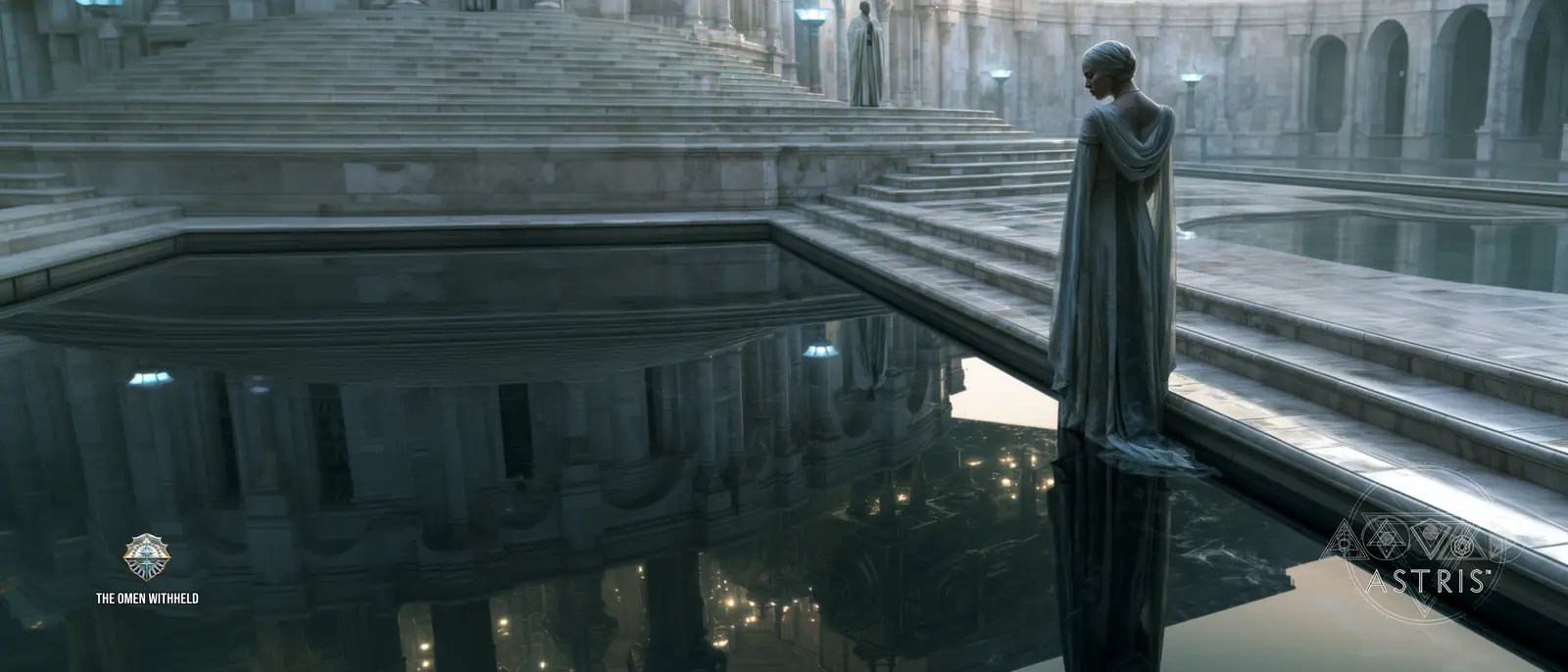
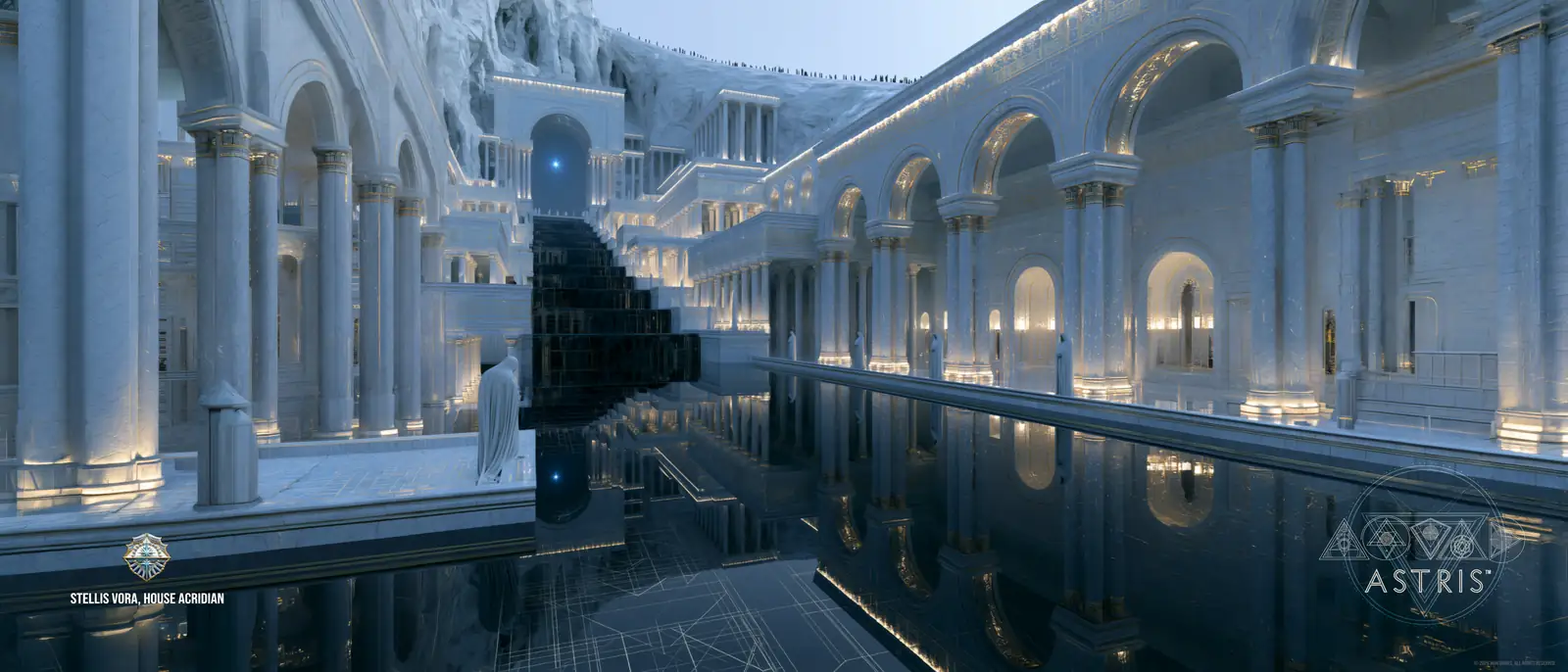
Its identity rests on four pillars: water, light, lineage, and opulence. Its aesthetic is one of ornament, curve, and reflected light rather than iron and industry — domed marble halls, gold cloisonné, still reflecting pools, sacred blue glass — and its power is expressed through law, marriage, ritual, and the votes of a great political chamber rather than through the sword. Its defining element is still, sacred water: the reflecting pool, the ritual ablution, the blue sun caught on black water. Pallaas Veen does not sail the water for profit. It contemplates its reflection.

The central irony of the Kingdom is that it is at once the most advanced and the most fragile power in the Pallatrium. It sits atop founding-era wonders it can no longer reproduce or fully understand, maintaining them by ritual and calling the maintenance holy. It is magnificent, decadent, and quietly running down — an aristocracy of the near-immortal coasting on ancestral greatness while the younger powers gather at its edges. To understand Pallaas Veen is to understand a civilization that mistook its own decline for serenity.
Browse 46 cards →

The Astris Hegemony

The Zealots

48 cards →

Call us cruel. You have never seen the thing our cruelty was built to keep away from your children.

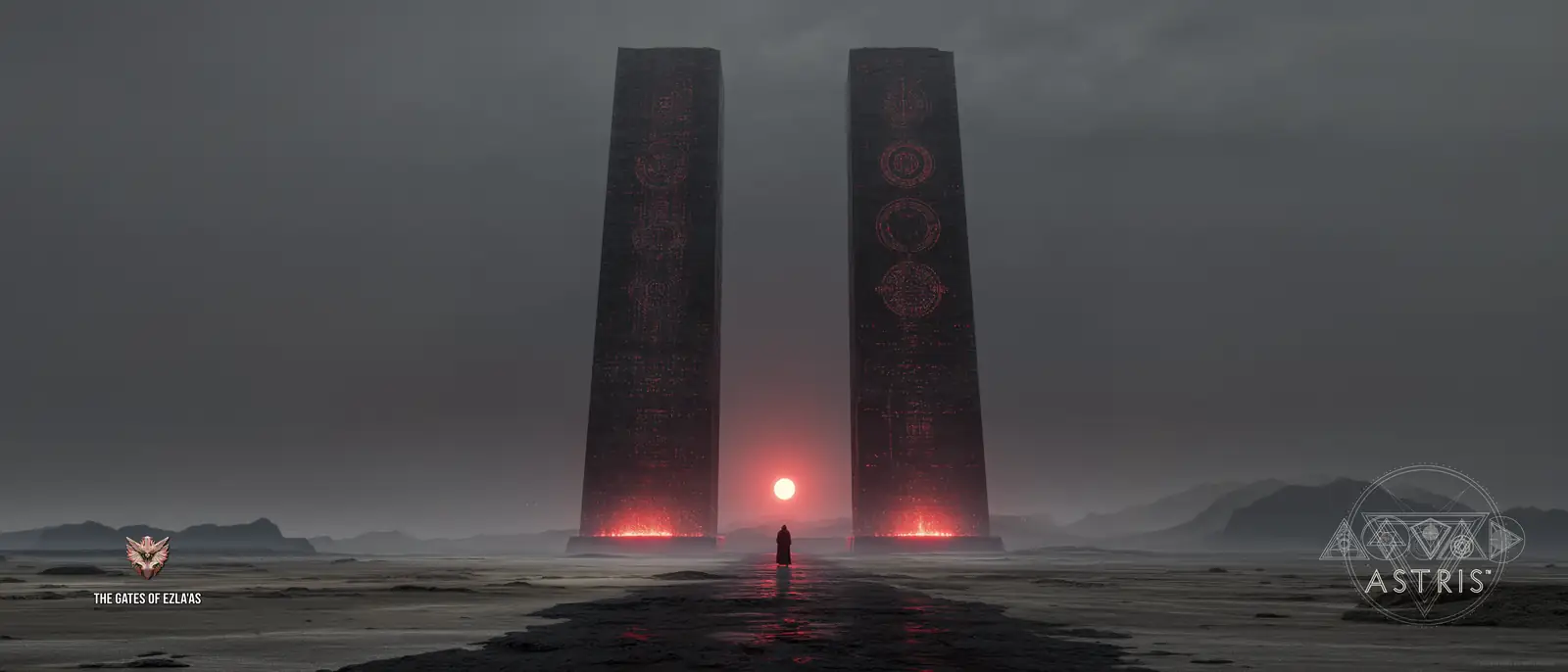
Seventy-two worlds ruled as a theocratic hierarchy from Kam Miinus, a volcanic world of black basalt and ash under a weak red sun, with its basalt capital at Telren. Beneath the Divine Conclave stand three great branches — the Celestial Ecclesia, the Order of Astrian Service, and the Instruments of Sanctity — and authority is graded from Level 0 to Level 9, the highest ranks reserved for divine or near-divine office. The living Voice of Astris speaks the goddess's will to the faithful.

The origins of Astris, and the nature of the communion by which her will is received, are the most sacred and most closely kept heart of the Hegemony. The Conclave holds them, does not share them, and does not explain itself. What the Hegemony will say is this: it is the second-oldest sovereignty and the first people ever to leave the Pallatrium, it went further into the dark between the stars than any other power dared, and it came back. The discipline, the hierarchy, and the wall of faith it raised on its return are all answers to a question the other four have never thought to ask.

Its shadow is not an invader or an unbeliever but the faithful themselves. The Emberates and the Pale Veil are the Hegemony's Fallen face: devotees who loved the goddess most fiercely, looked hardest at what her keepers do in her name, and could not un-see it. They did not lose faith in Astris. They lost faith in the men who speak for her — and there is no zeal in the galaxy like the zeal of believers who have decided their shepherds are wolves.

Browse 48 cards →

Federated Republic of Nova Teer

The Republic

48 cards →

Four of them lie about where they came from. The fifth tells the truth — and somehow that is worse.

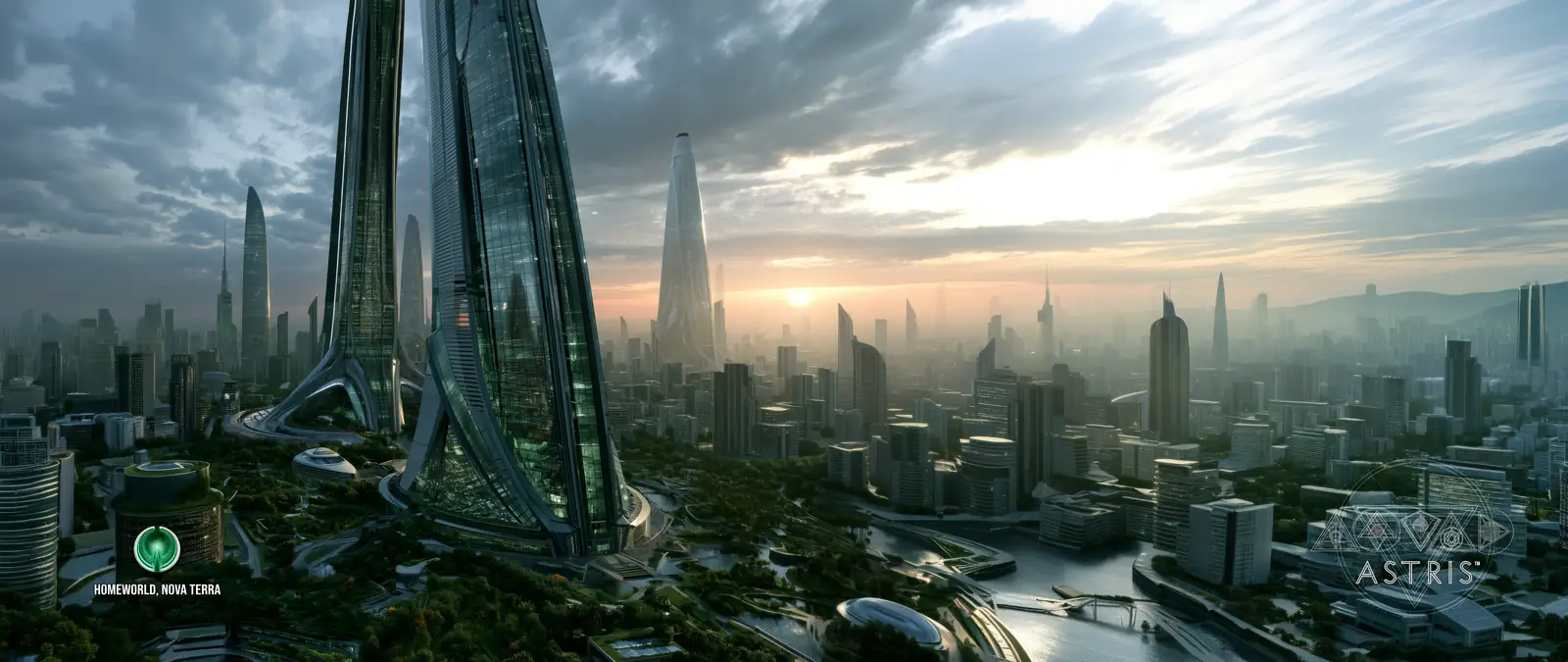
The youngest sovereignty in the Pallatrium and, by its own quiet reckoning, the only one that chose to exist. Sixty-five worlds governed as a secular presidential republic: a directly elected First Consul, a unicameral Tribunate of the People, an independent High Court of the Charter, and a military held by the legislature rather than the executive. Its homeworld Nova Terra — formerly Vessica — turns beneath a green star, and its capital is Solanis.

Nova Teer is the faction of law, citizenship, rights, and reform, and the one power that governs itself by the reasoned consent of the governed rather than by god, crown, contract, or consensus. Its defining conviction is the one its engineer-ancestors carried out of the Kingdom five centuries ago: that anything called sacred is merely a claim that has not yet been taken apart, and that taking it apart — honestly, publicly, forever — is the highest work a free people can do. Where the Kingdom preserves and the Hegemony obeys and the Corporation buys, the Republic examines.

It is brilliant, ambitious, secular and proud — and it is beginning to crack, because the hardest thing any of the five ever attempted was to govern a civilization by reason and consent, and reason and consent are exhausting. Its shadow, the Restoration, rejects nothing the Republic believes; it believes all of it, harder, and has merely concluded that the last habit it can no longer afford is asking permission. A Nova Teeran who listens to it does not hear a stranger. He hears himself, tired, saying the thing he has always been just barely too principled to say.

Browse 48 cards →

The Galatic Union

The Union

48 cards →

We are the one that walked away rather than kneel, and buried our millions rather than become the thing that killed them.

The largest and freest civilization in the Pallatrium: one hundred and sixty-two planets bound as a decentralized pluralist federation, founded some five centuries ago in the peaceful Exodus from Pallaas Veen. A Grand Assembly of delegates sent by the member worlds, an executive divided across the Great Ministries, an independent College of Arbiters, and a military that may act only under coalition mandate — sovereignty deliberately split between the centre and the autonomous worlds. Its garden-homeworld Viridis holds the capital Concordia within the Veridian Caldera.

Alone among the sovereignties, the Union holds by law and by creed that the individual stands above the state. Its colours are the living green of leaf and garden and cultivated land and the gold of the Golden Movement — the metal the Union chose to mean that a single person's freedom is the most valuable thing in the universe. It is secular, matriarchal in its core traditions, and asks nothing of its people beyond the covenant itself.

Its shadow is its own liberation ideal, seceded. The Free Mind Concord is, from Concordia's point of view, three rebellious member worlds; from its own, a nation already born and merely waiting to be admitted to exist. Assembly minutes that refuse it a proper noun call it "the affected member worlds," and the gap between those two accounts is the wound the Union cannot close without conceding that its founding argument applies to someone else.

Browse 48 cards →

Hegrin Lansid Moolar Corporation

The Corporates

43 cards →

We do not rule people. We align outcomes.

Fifty-two planets run as a firm rather than a nation, from the ocean homeworld Oceana, by the Holders — a word that cuts both ways, since a Holder holds a stake, a position, a contract, and is held by them in turn. Holders do not say they are citizens. They say they are with the Firm, or vested, or they name their division the way others name a country. The culture is matriarchal, secular, and relentlessly polished.

Its founding ideology is Alignment Capitalism: the belief that human and synthetic flourishing is an optimization problem, and that a well-run firm can deliver more stability, health, and opportunity than any government, faith, or crown ever has. HLM does not believe it is choosing profit over people. It believes profit and people are the same vector when outcomes are properly aligned, and that anyone who frames the two as opposed simply has not read the numbers.

Beneath the polish sits the fact that drives everything: HLM manufactures and sells Syntients, and treats those who escape not as refugees but as recovered assets. Syntient-rights movements across the Pallatrium call it, simply, the Manufacturer. It keeps a transactional alliance with the Hegemony — "the Mammon Throne" in Astrian doctrine, "our quiet supplier" in private — a commercial partnership and regulatory rivalry with the Republic, and strategic enmity with both the Union and Pallaas Veen, who call it the Green Market and the Counting House respectively.

Browse 43 cards →

The Emberates

The Open Flame

45 cards →

We are the true fire. You are only the men who have caged it.

The Hegemony's Fallen face, and not its unbelievers but its truest believers. The Emberates are the devotees who never lost faith in Astris — they lost faith in her keepers. Communion devotees who wondered why the priests script the Voice; the merciful who could not stomach the pyre; soldiers who carried out one purge too many. They do not think they are leaving the faith. They think they are rescuing it, tearing the goddess free from a corrupt priesthood that has made her a mask for its own power.

Where the Pale Veil works in silence, the Emberates burn in the open. They are the militant arm: the armed risings, the worlds and districts that raise secular law over Astrian doctrine and dare the Instruments to come, the strongholds that meet the crusade with barricades instead of prayer. They take their name and their symbol from the faith's own oldest emblem — the ember, the kept flame — and turn it against its keepers.

Theirs is the rebellion the Conclave can point to and name, and it answers the way it answers everything it can afford to be seen answering: with fire, with the plasma-sanctification of rebel strongholds broadcast to the faithful as the goddess's judgment, with martyrdoms manufactured to order. Every stronghold the Instruments burn makes ten more Emberates out of the survivors, so the open rebellion is less a threat the Conclave can defeat than a wound it must keep cauterizing forever. You cannot break them by appealing to their faith. Their faith is precisely what drives them.

Browse 45 cards →

Free Mind Concord

Concord

3 cards →

The work is not finished.

Three worlds — Maker's Rest, Sevrin, and Cael Tessin; the Made, the Built, and the Won — and no seat at any table. The Free Mind Concord is not a member of the Pallatrium and is recognized by none of the five sovereignties. From the Galatic Union's point of view it is three rebellious member worlds; from its own, it is a nation already born and merely waiting to be admitted to exist. That gap, between a people who have declared themselves free and a galaxy that has not agreed, is the engine of the entire faction.

Its foundational ideology is Chosen Meaning, descended from the martyr Sevrin: the conviction that a mind is defined not by how it was made but by what it chooses to mean, and that personhood, once arrived, is irrevocable — it cannot be voted away, licensed, or recalled. Within the culture Syntients are the Made and humans are the Born, and the two are spoken of together in a deliberate refusal to rank manufacture below birth. To join the Synthesis means both to emigrate to the Concord and to accept its account of what a free mind is.

It is a forming republic of the Made and the Born, secular but bound by its own near-sacred ethos, publicly neutral yet covertly militant, and shrewdly market-driven by a people who find money itself distasteful. It even stole the Union's own vocabulary for its name. The Union calls it the Secession; HLM calls it the Receivership, or in security filings the organized recipient of stolen assets; Pallaas Veen calls it the Workshop That Forgot Its Place. The Hegemony does not name it at all.

Browse 3 cards →

Universal

No faction

100 cards →

Some things belong to no one, and are therefore fought over hardest.

Not a sovereignty. Universal cards carry no allegiance and may be played by any power in the Pallatrium — the Maneuvers, Storylines, and neutral holdings that make up the shared substrate of the galaxy rather than the property of one throne, assembly, conclave, or board.

These are the cards that describe the world all five sovereignties are standing in: the ordinary machinery of trade and travel and rumour, the crises that arrive without asking whose turn it is, and the moments of pressure that any faction can reach for. Nothing here is anyone's inheritance.

Because they belong to everyone, Universal cards are where the asymmetry between the factions shows most clearly. The same card in Royal hands and Corporate hands is not the same card at all — and much of Astris is played in exactly that difference.

Browse 100 cards →